Как сделать ИИ-тренд с геликом, шампанским и ночной трассой через Aigrator

Как сделать ИИ-тренд с геликом
Самое удобное здесь то, что весь процесс можно собрать внутри Aigrator. Отдельно искать сервис для подготовки персонажа и ещё один сайт для видео не нужно. Сначала я создаю хороший референс персонажа в разделе изображений, затем перехожу в генерацию видео и использую этот же файл в Seedance 2.5.
Для старта понадобится только одна фотография человека. Лучше всего использовать качественное селфи или портрет, где лицо хорошо видно, а внешность не перекрывают сильные тени.
Исходный workflow рассчитан на создание карты персонажа и последующую десятисекундную генерацию в вертикальном формате 9:16.
Что получится в итоге
Ролик строится как один непрерывный кадр.
Камера находится в соседнем движущемся автомобиле. Слева едет тёмный G-Class, по дороге льёт сильный дождь, мокрый асфальт отражает фонари.
Через открытое пассажирское окно высовывается человек с вашей фотографии. Он открывает шампанское, взаимодействует с камерой, после чего возвращается в салон, а внедорожник ускоряется.
Главная сложность такой генерации не в самой машине. Нужно одновременно удержать:
-
лицо человека;
-
одежду;
-
геометрию автомобиля;
-
реальное движение двух машин;
-
дождь;
-
бутылку;
-
руки;
-
последовательность действий.
Поэтому я не начинаю сразу с Seedance. Сначала готовлю нормальный референс персонажа.
Шаг 1. Подготавливаем персонажа в Aigrator
Открываем Aigrator и переходим в раздел генерации изображений.
Для подготовки персонажа можно использовать доступную модель для работы с фотографиями. В исходной схеме используются Grok Imagine 2.0 или GPT Image, а задача модели заключается не в создании красивой сцены, а в подготовке понятного референса человека.
Загружаем фотографию.
Оптимальный формат для карты персонажа: 16:9. Если доступна настройка высокого разрешения, выбираем повышенное качество.
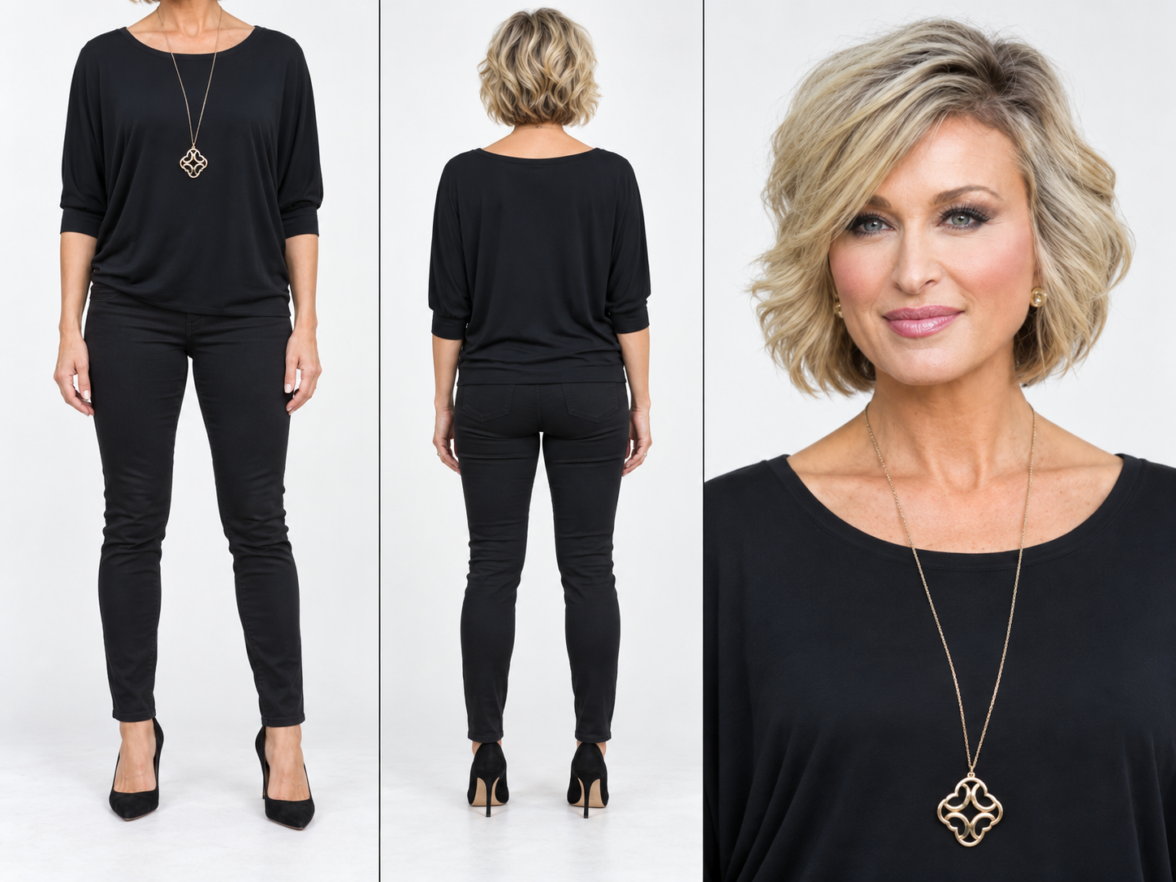
Дальше вставляем промт.
Промт для карты персонажа
Create a photorealistic character reference sheet from the uploaded person photos: three vertical panels, clean white or light-gray background, clear vertical dividers.
RIGHT: Shoulder-cropped frontal portrait, direct gaze, neutral expression, soft even light. Preserve identity: facial proportions, eyes, nose, lips, brows, ears, skin tone and texture, hair color and shape, moles and freckles. Highly detailed, natural realism.
LEFT: Front view, framed from the neck/shoulder line down to the feet; head and face outside the crop. Standing upright, arms at sides, feet shoulder-width apart, wearing the person’s everyday clothing. Preserve build, proportions, and outfit details.
MIDDLE: Full-body BACK view, including the head and hair from behind. Same person, build, proportions, and outfit.
Keep identity, clothing, lighting, and photographic style consistent across panels. Match body scale in the left and middle panels. High resolution, realistic anatomy and fabric.
Этот формат удобен тем, что в одном изображении видеомодель получает сразу несколько типов информации.
-
Справа она видит лицо крупно.
-
Слева получает телосложение и одежду спереди.
-
В центре видит персонажа со спины.
То есть Seedance не приходится полностью додумывать тело человека по одному портрету.
Можно ли использовать обычное селфи
Да. Если хорошая карта персонажа не получилась, можно загрузить в Seedance обычную фотографию. В исходной инструкции этот вариант также допускается.
Но я бы всё же сначала попробовал сделать карту. В видео человек поворачивается, наклоняется, пьёт из бутылки и взаимодействует с автомобилем. Чем больше информации модель получает о внешности, тем проще ей сохранять персонажа.
Шаг 2. Переходим к генерации видео в Aigrator
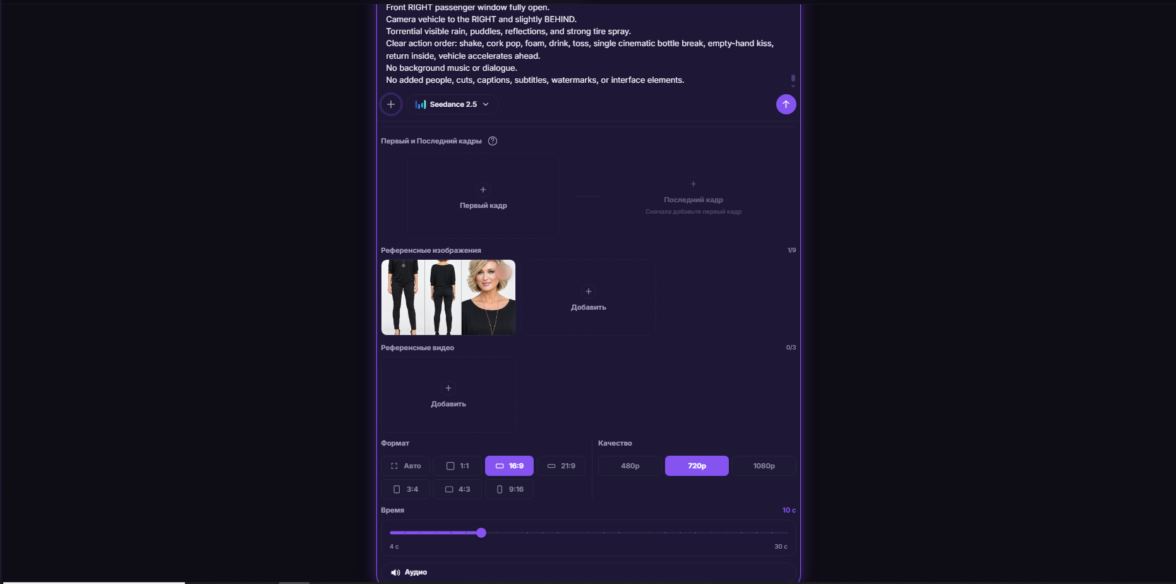
Теперь остаёмся в Aigrator и открываем раздел видео. Выбираем Seedance 2.5. Для этого тренда нужны следующие настройки:
-
качество: 720p;
-
формат: 9:16;
-
длительность: 10 секунд.
Для тестовой генерации можно выбрать более экономичный вариант качества, если он доступен в интерфейсе. Финальную версию уже имеет смысл делать в лучшем разрешении.
Загружаем созданную карту персонажа или исходное фото. В промте этот файл будет обозначаться как:
@image1
Проверьте, что ссылка действительно привязана именно к вашей фотографии. Весь внешний вид главного героя Seedance будет брать из этого референса. В исходной инструкции отдельно закреплено, что @image1 определяет лицо, возраст, телосложение, одежду и аксессуары персонажа.
Готовый промт для Seedance 2.5
Сам промт лучше не сокращать. Генерация видео ставим на 10 секунд. В нём отдельно описаны машина, камера, дождь, действия персонажа, тайминг и физическая непрерывность объектов.
[TASK — NIGHT HIGHWAY CELEBRATION]
Create a 10-second photorealistic cinematic video, vertical 9:16, 24 fps.
One continuous tracking shot filmed from a moving car travelling beside and slightly behind a dark plum-burgundy Mercedes-Benz G-Class on a rain-soaked highway at night.
An adult passenger defined by @image1 leans through the open front passenger window, shakes a champagne bottle, drinks through overflowing foam, tosses the bottle into the air, and shatters it with a single fictional cinematic gunshot. The passenger blows a kiss toward the camera and returns inside as the G-Class accelerates ahead.
No background music at any point.
[REFERENCE ROLES]
@image1 defines the adult passenger’s complete identity, gender presentation, apparent adult age, facial structure, skin tone, hairstyle, facial hair where present, physique, clothing, and accessories.
If @video1 is also supplied, use it only as a visual guide for staging, camera relationship, action order, and energy. Do not copy its original performer or soundtrack.
The written requirements below take priority for identity, rain intensity, absence of license plates, and audio.
[COMPLETE CHARACTER CONSTRUCTION]
Build the complete person from @image1, then animate that person performing the scene.
Preserve their own skull shape, forehead, cheeks, jawline, nose, lips, neck, shoulders, and body proportions.
Do not paste their face onto the original performer’s head or body.
Do not inherit the source performer’s gender, hairstyle, glasses, physique, or outfit.
Use the photographed clothing and accessories, with realistic wet fabric and wind response.
If the photograph shows no glasses, add no glasses.
Maintain recognizable identity during drinking, smiling, turning, and the final kiss.
The passenger is clearly an ADULT.
[VEHICLE]
A recognizable Mercedes-Benz G-Class with a deep plum-burgundy / dark wine-purple paint finish.
Boxy proportions, coherent windows and doors, realistic wheels, and wet bodywork reflecting passing highway lights.
NO LICENSE PLATES anywhere on the vehicle.
Do not show blurred, blank white, black, temporary, or decorative plates. The plate mounting areas are empty.
Keep the same vehicle geometry and paint throughout.
The front passenger window on the vehicle’s RIGHT side is fully lowered.
The passenger’s upper body extends through this open window while the lower body remains supported inside the cabin.
No movement through closed glass, roof opening, or rear window.
The passenger is not driving.
[CAMERA AND SPATIAL RELATIONSHIP]
Both vehicles are driving FORWARD along the highway in the same direction.
The camera car travels in the adjacent lane to the RIGHT of the G-Class, slightly behind it, initially matching its speed.
The camera films through the camera car’s OPEN LEFT SIDE WINDOW, looking diagonally forward-left toward the G-Class’s open right passenger window.
The G-Class occupies the left and central area of the composition.
[SUBTLE CAMERA-CAR MIRROR IN FRAME]
Keep a very small, partially cropped glimpse of the CAMERA CAR’S exterior LEFT SIDE MIRROR at the extreme lower-left edge of the frame.
Only a narrow portion of the wet mirror housing and mirror glass is visible, approximately 2–4 percent of the image area.
This is a subtle foreground cue that the footage is being recorded through an open window of another moving car.
The mirror belongs to the CAMERA CAR, not the G-Class. It is an exterior side mirror, not an interior rear-view mirror.
Keep it naturally soft and secondary, with small rain beads and occasional passing light reflections.
Do not center it, focus on it, enlarge it, or let it block the passenger, bottle, or main vehicle.
Do not show a large section of the camera car’s door, dashboard, cabin, driver, or window frame.
There is no closed window glass between the camera and the scene.
[FORWARD TRAVEL AND CAMERA MOTION]
Clearly convey continuous forward travel through road markings flowing backward, passing streetlights, moving reflections, and tire spray.
The camera car is never parked or stationary beside the road.
Use a moderately wide, approximately 32–35 mm cinematic perspective with enough headroom for the tossed bottle.
Include subtle road vibration and restrained handheld movement from inside the travelling car.
The small mirror fragment stays anchored near the frame edge with only natural vibration and minor framing changes. It must not float independently.
During the final acceleration, the G-Class gains speed and pulls farther ahead while the camera car CONTINUES MOVING FORWARD at roughly its previous speed.
The growing distance comes from the G-Class accelerating, not from the camera car stopping, reversing, or the camera zooming out.
No drone view, orbit, reverse angle, digital zoom, or camera movement through either vehicle.
A restrained upward adjustment may follow the bottle before returning to the passenger.
One uninterrupted shot, no cuts or slow motion.
[WEATHER — TORRENTIAL RAIN]
Heavy, clearly visible rain throughout the entire shot.
Dense rain streaks cross the headlight and streetlight beams, with direction shaped by gravity, wind, and the moving vehicles.
The road contains shallow puddles and a continuous wet sheen.
Tires throw convincing sheets of spray backward, with turbulent mist close to the road.
Streetlight reflections stretch across the wet asphalt and break apart in puddles.
Water beads and streams over the burgundy bodywork.
Hair and clothing become visibly wet and respond to airflow.
Keep the passenger’s face and actions readable despite the rain.
This is not merely a dry scene with a rain overlay or wet road.
Avoid large lens droplets that obscure the action.
[LIGHTING AND IMAGE]
Night highway illuminated by regularly spaced roadside lamps, vehicle lights, and reflected light from wet pavement.
Deep night shadows, readable skin, controlled highlights, and rich plum-burgundy paint.
Natural cinematic contrast, realistic motion blur, textured skin, and restrained grain.
Passing lamps produce coherent moving highlights across the face and vehicle.
No daylight, studio lighting, neon fantasy palette, beauty-filter skin, or excessive lens flare.
[ACTION TIMELINE — EXACTLY 10 SECONDS]
00:00–00:02.0 — SHAKE:
Begin with the passenger already leaning through the open window.
They hold one champagne bottle with BOTH hands, lifting it near or slightly above head level and shaking it energetically.
The person looks exhilarated and playful.
Keep the bottle, hands, face, and passenger window readable.
00:02.0–00:03.2 — CORK AND FOAM:
The cork pops free once.
A substantial burst of champagne foam spills and sprays from the neck.
The airflow carries fine droplets and foam backward relative to the moving car.
Use believable liquid weight and gravity, not a rigid white stream.
00:03.2–00:04.6 — DRINK:
The passenger immediately brings the bottle to their mouth for a brief drink.
Overflowing foam reaches the lips, cheeks, and chin, with some falling onto the clothing.
Preserve a lively, delighted expression and recognizable facial anatomy.
No speech.
00:04.6–00:05.6 — TOSS:
The passenger pulls the bottle away and tosses it upward into the clear space above and outside the vehicle.
Show one coherent bottle leaving the hand and following a continuous airborne arc.
Do not duplicate it, teleport it, or make it hover.
00:05.6–00:06.8 — CINEMATIC BOTTLE BREAK:
The passenger produces a handgun prop from a clothing pocket or concealed clothing position without changing the photo-defined outfit.
A single brief cinematic shot is directed toward the airborne bottle, away from the camera, people, and vehicles.
Show a restrained muzzle flash followed by the bottle shattering at its actual airborne position.
Use fictional action-film effects: a brief readable burst of glass fragments and remaining liquid, falling naturally away from the passenger.
No shooting at people, injuries, blood, repeated gunfire, weapon close-up, or instructional handling detail.
The bottle does not reappear intact.
00:06.8–00:08.2 — KISS TO CAMERA:
The weapon is lowered out of view and is no longer aimed anywhere in frame.
The passenger turns toward the camera car with a playful smile.
With an EMPTY hand, they touch their fingers to their lips and send one clear airborne kiss toward the camera.
Do not use the hand holding the weapon for this gesture.
No spoken words.
00:08.2–00:10.0 — RETURN AND ACCELERATION:
The passenger withdraws smoothly through the same open window into the cabin.
At the same time, the G-Class accelerates forward relative to the camera car.
Show a clear increase in separation: the SUV moves farther ahead, with its rear becoming more prominent and tire spray trailing behind.
Keep the camera in the following car; do not magically accelerate it to maintain the same close framing.
Finish with the G-Class pulling away through the heavy rain.
[PHYSICAL CONTINUITY]
One passenger, one champagne bottle, one cork, and one handgun prop.
Objects move through continuous trajectories with clear hand contact and release.
Maintain correct fingers, wrists, elbows, and support at the window.
Do not merge hands with the bottle, weapon, door, or face.
The same bottle is shaken, opened, drunk from, tossed, and shattered.
Foam residue remains naturally on the face and clothing until rain washes or dilutes it.
The passenger never stands on the road or appears outside the vehicle unsupported.
Maintain coherent road motion, wheel rotation, spray, reflections, and acceleration.
[AUDIO — NO MUSIC]
Generate only diegetic environmental and action sound:
heavy rain,
tire hiss and water spray,
wind,
engine and acceleration,
the cork pop,
champagne fizz and splashing,
one brief cinematic gunshot,
and glass breaking.
Optional brief natural laughter may be nonverbal only.
ABSOLUTELY NO background music, soundtrack, beat, song, instrumental score, cinematic drone, or musical transition.
No dialogue, narration, intelligible words, singing, or lip-sync.
If a source video is supplied, do not retain its music or mixed soundtrack. Rebuild only the requested diegetic sounds.
[FINAL PRIORITIES]
Exactly 10 seconds, vertical 9:16, one continuous shot.
Complete adult identity and outfit from @image1.
Dark plum-burgundy G-Class with NO license plates.
Front RIGHT passenger window fully open.
Camera vehicle to the RIGHT and slightly BEHIND.
Torrential visible rain, puddles, reflections, and strong tire spray.
Clear action order: shake, cork pop, foam, drink, toss, single cinematic bottle break, empty-hand kiss, return inside, vehicle accelerates ahead.
No background music or dialogue.
No added people, cuts, captions, subtitles, watermarks, or interface elements.
Почему промт такой длинный
На первый взгляд для десятисекундного ролика инструкций слишком много. Но именно здесь длинный промт оправдан. Если написать просто:
Девушка едет ночью в G-Class, пьёт шампанское под дождём.
модель получает слишком большую свободу. Она может посадить человека за руль, открыть люк вместо пассажирского окна, остановить машину, изменить цвет автомобиля или сделать дождь обычным визуальным фильтром.
Поэтому здесь отдельно закрепляется даже взаимное расположение машин. Камера находится справа и немного сзади, а снимающий автомобиль продолжает двигаться вместе с G-Class. Это помогает создать ощущение настоящего дорожного кадра.
Почему машина должна двигаться всё время
Один из элементов, который особенно сильно влияет на реализм, это фон. Разметка должна постоянно уходить назад. Фонари проходят мимо. От колёс летит вода. Отражения на мокром асфальте двигаются вместе с автомобилями.
Если дорога становится неподвижной, а персонаж просто машет бутылкой в движущемся фоне, эффект теряется. В исходном промте движение двух автомобилей поэтому зафиксировано отдельно.
Как добиться нормального дождя
Обычной фразы heavy rain иногда недостаточно. Модель может сделать мокрый асфальт и пару полос дождя перед объективом, но сама сцена всё равно будет выглядеть почти сухой. Здесь дождь влияет сразу на всё:
-
машина покрыта водой;
-
от шин идёт спрей;
-
волосы намокают;
-
одежда реагирует на ветер;
-
в лужах ломаются отражения фонарей;
-
капли пересекают свет фар.
Так сцена начинает ощущаться единой, а не как видео, поверх которого наложили эффект осадков.
Как сохранить лицо человека
Если персонаж начинает меняться, я в первую очередь проверяю исходный референс. Для этого тренда важно хорошо видеть:
-
форму лица;
-
волосы;
-
телосложение;
-
одежду.
Особенно сложный момент приходится на середину ролика, потому что человек активно двигает головой, пьёт из бутылки и затем поворачивается к камере. Именно поэтому в начале я рекомендую подготовить полноценную карту персонажа.
Можно ли сделать всё только по селфи
Можно. Загрузите хорошее селфи непосредственно в Seedance 2.5 и используйте его как @image1. Но для максимально стабильной внешности я бы использовал двухэтапную схему: фото → карта персонажа → видео. В Aigrator оба этапа выполняются в одном сервисе, поэтому дополнительный аккаунт для подготовки изображения не нужен.
Что делать, если Seedance перепутал окно автомобиля
В промте специально указано, что человек находится в переднем пассажирском окне справа. Это важно из-за положения камеры. Снимающий автомобиль едет справа от G-Class и снимает через своё левое окно. Поэтому пассажир оказывается ближе к камере.
Если Seedance переносит человека к водителю или в люк, не нужно полностью переписывать запрос. Обычно достаточно повторить генерацию с тем же референсом и сильнее закрепить блок VEHICLE.
Почему в кадре видна часть зеркала
Это небольшая, но полезная деталь. В левом нижнем углу должен едва просматриваться кусок бокового зеркала автомобиля, из которого ведётся съёмка. Оно занимает всего несколько процентов кадра.
Зритель практически не обращает на него внимания сознательно, но благодаря такой детали становится понятнее, откуда снимают G-Class. Если сделать зеркало слишком большим, оно начнёт мешать. Поэтому в промте отдельно запрещено помещать его в центр или делать главным элементом сцены.
Как сделать финал убедительным
В последние секунды персонаж возвращается внутрь машины. После этого G-Class начинает уходить вперёд. Камера при этом не останавливается. Это важно.
Если просто уменьшить внедорожник через цифровой zoom-out, сцена будет выглядеть искусственно. Машина должна физически увеличить расстояние до камеры. Seedance получает прямую инструкцию: ускоряется именно G-Class, а автомобиль с камерой продолжает двигаться примерно с прежней скоростью.
Весь процесс внутри Aigrator
В результате для повторения тренда не требуется собирать цепочку из нескольких сервисов. Я бы делал так:
-
Загружаю фото в Aigrator.
-
В разделе изображений создаю карту персонажа.
-
Сохраняю лучший вариант с максимально узнаваемым лицом.
-
Перехожу в раздел видео.
-
Выбираю Seedance 2.5.
-
Загружаю карту персонажа как @image1.
-
Ставлю 9:16 и 10 секунд.
-
Вставляю готовый промт.
-
Проверяю привязку референса и запускаю генерацию.
То есть и подготовка фотографии, и основное видео выполняются через Aigrator.
Что проверить перед финальной генерацией
Перед дорогим запуском я бы посмотрел на три вещи. Во-первых, узнаваем ли человек на подготовленной карте. Во-вторых, точно ли @image1 связан с нужным изображением. В-третьих, сохранены ли ключевые параметры ролика: 9:16, 10 секунд, одна непрерывная сцена.
Сам исходный сценарий также требует отсутствия добавленных персонажей, субтитров, интерфейсных элементов и водяных знаков.
Итог
Этот тренд выглядит как сложная киношная сцена, но для пользователя процесс получается достаточно понятным. Нужна всего одна фотография. Сначала через Aigrator я превращаю её в полноценный референс персонажа. Затем в этом же сервисе открываю Seedance 2.5 и создаю десятисекундное видео.
Главное здесь не пытаться сократить весь запрос до одной фразы. В ролике слишком много взаимосвязанных деталей: человек, окно автомобиля, бутылка, дождь, движение машин и камера. Чем точнее эти связи зафиксированы, тем выше шанс получить сцену, которая действительно выглядит как снятый ночью дорожный ролик, а не случайная AI-анимация.




Другие статьи